By Rachel Haselow, Nikoleta Despodova, Daniel Wolfe, and Richard Wiener

Introduction
In 2014, the Iowa Supreme Court used the term “deep-pocket jurisprudence” to describe litigation in which jurors assign more responsibility to the party more able to pay for damages (Huck v. Wyeth, Inc., 2014, p. 380) This idea was not new (Schwartz, Goldberg, & Appel, 2017); in fact, Chin and Peterson (1985) published data testing the “deep pocket” hypothesis almost 30 years before the Iowa Supreme court coined the term deep-pocket jurisprudence. They examined over 9,000 civil cases decided between 1959 and 1979 in Cook County, Illinois, statistically controlling for the differences in the types of causes of action, the attributes of the litigants, and the factors associated with other parties involved. They found that corporate defendants paid out more money than did individuals, and that governments paid out even more than corporations (Chin & Peterson, 1985). This paper reviews the findings to date and then reports on data collected in a national survey to try to understand more about juror prejudice against large corporations.
In an early experimental study of the deep pocket hypothesis, Hans and Ermann (1989) found that participants awarded plaintiffs significantly more money for compensatory injuries (i.e., hospital bills, doctor bills, and pain and suffering) when the defendant was a corporation in a mock jury vignette. Furthermore, participants viewed the corporation as having “deeper pockets” as measured by expected insurance coverage, likelihood of filing bankruptcy, and the fairness of the claims against the defendant.
Despite these early supportive results, others have failed to replicate the findings. For example, Vidmar et al. (1994) found that while respondents did assign more responsibility to a hospital defendant accused of medical malpractice than to a reckless driver who caused an accident, there were no differences in the amount of damages awarded. One explanation for the inconsistency in these research findings could be factors other than the wealth status of the defendants in these studies. In another experiment (MaCoun, 1996), six versions of Hans and Ermann’s (1989) experiment varied defendant wealth alongside whether the defendant was an individual or a corporation. Alas, in this instance, the differences in compensatory damage awards depended upon factors other than the defendants’ wealth or whether they were a corporation or an individual.
MacCoun (1996) ultimately concluded that the differences between corporations and individuals that affect damage awards may have more to do with how citizens perceive the responsibilities that corporations bear rather than differences in perceived wealth. Below, we expand upon that sentiment and report on the results of a large-scale exploratory survey conducted to determine some of the factors that predict litigation attitudes about large corporations. Elucidating some of these factors could yield value in both jury selection and in helping to develop stronger arguments for both plaintiff and defendant attorneys in cases against large corporations.
Method
Overview
The present data originated from the National Community Attitude Survey on Corporate Perceptions, a large-scale nationwide study aimed at understanding public sentiment toward corporate entities, litigation (i.e., especially intellectual property lawsuits), and perceptions of corporate responsibility in the legal system. Magna Legal Services surveyed five key federal court venues: Southern District of New York (SDNY), District of Delaware (DD), Northern District of California (NDCA), Eastern District of Texas (EDTX), and Western District of Texas (WDTX). One hundred jury-eligible participants were recruited from each of the five key federal venues, for a total of five hundred respondents. Each venue was chosen due to its significance in corporate litigation, particularly in intellectual property disputes, patent litigation, and corporate regulatory matters. The study gathered insights into jurors’ predispositions toward corporations, their understanding of patent systems, biases in litigation, and perceptions of corporate ethics. The main objectives of the National Community Attitude Survey were: (1) to identify juror biases and perceptions of Corporate America, (2) understand public sentiment regarding intellectual property and patent litigation, (3) explore juror reactions to litigation as a business strategy, (4) compare juror attitudes across key venues, and (5) to enhance litigation strategy and jury selection. The analyses reported below focus on juror reactions to large corporations in litigation generally and specifically in the context of patent disputes.
Description of the Survey
Respondents were pre-screened to ensure that they were jury-eligible adults and then completed a survey that took approximately 45 minutes. First, respondents answered demographic questions such as gender, age, and household income. Next came questions to measure participants’ attitudes toward and knowledge of corporations, intellectual property, and patents, comparisons between large and small companies, and various other relevant topics. From this larger survey, we focused on two outcome variables that examined biased attitudes toward large corporations: 1) views of general lawsuits filed against large companies (GLALC) and 2) views of patent litigation financed by NPEs against large companies (PLALC).
Demographic and attitude items were utilized as potential predictors of the variance in the two litigation financing questions. In addition, there were general attitude questions related to ideology and political party. Finally, four factors related to specific attitudes emerged for additional analyses. These were a) the belief that a large number of patents promotes positive views of the company (e.g., having numerous patents reflects positively on the company’s commitment to protecting its intellectual property), 2) the belief that patent litigation breeds mistrust (e.g., I wouldn’t trust a company that was defending itself in several patent lawsuits), 3) the belief that reputation doesn’t matter in litigation (e.g., intellectual property protection is not important when evaluating a company’s reputation), and 4) the level of mistrust of foreign companies (e.g., companies located outside the United States are less trustworthy than US companies).
Results
Analytic Plan
First, we examined all univariate relationships for each of the two litigation financing outcome variables and the predictors using chi-square, Pearson correlation, and Univariate Analyses of Variance tests, depending on the level of measurement of the predictors. Second, with the significant univariate predictors and their interactions with venue, we developed prediction equations using general linear models for each outcome factor to account for the most variability in perceptions of litigation financing. These results are described in further detail below.
General Lawsuits Financed Against Large Companies (GLALC)
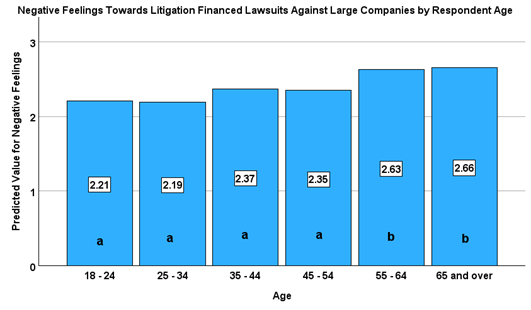
Post-hoc effects for the significant univariate effects for generation show that Baby Boomers (1946 to 1964) had the most negative feelings (M = 2.63) toward litigation financed against large corporations, significantly more negative than millennials/GenY (1980 to 1994) (M = 2.32), and Generation Z (1995 to 2009) (M = 2.19). Further, Generation X (1965 to 1979) (M = 2.48) was significantly more negative than Generation Z. Together, these results support a roughly linear relationship between age and attitudes toward financed litigation against large companies. In general, older respondents disfavored litigation against large corporations more than the younger participants. In addition, the significant univariate effect for race showed that Black respondents had the least negative ratings (M = 2.18), less negative than White (M = 2.46) or Asian (M = 2.59) participants.
The results of the general linear prediction model accounted for the most variance in participants’ negative feelings toward general litigation against large companies (R2 = .169, about 17% of the variance). First and foremost, it provided further evidence that, compared to younger respondents, older respondents showed more positive views of large corporations. Additionally, the univariate and multivariate results together suggest that jurors who would be most sympathetic towards large companies during litigation would be older, believe that reputation doesn’t matter, and that a large number of patents promotes positive views of the company. These types of jurors may be generally favorable to defense attorneys defending large corporations and hamper attorneys representing plaintiffs suing those corporations.
Figure 1. Negative Feelings Towards Litigation Financed Lawsuits Against Large Companies by Respondent Age
Lawsuits Financed by NPE’s Against Large Companies
Utilizing a general linear model, six factors emerged as significant predictors of attitudes toward lawsuits financed by NPE’s against large companies: age, political party, household income, the belief that a large number of patents promotes a positive view of the company, the belief that reputation doesn’t matter, and the belief that patent litigation breeds mistrust. Once again, the data shows that older respondents had stronger negative feelings about lawsuits that NPEs were pursuing towards larger corporations; that is, they were more sympathetic towards large corporations in these cases. With respect to political party, Independents had the most negative views of these lawsuits, significantly different from Democrats and third-party identifiers. Generally, respondents from higher-income households held more negative views of litigation in these cases. Finally, those who held the following beliefs showed more negative views of NPE lawsuits brought against large corporations (i.e., were sympathetic to large corporations in these cases): 1) a large number of patents promotes positive views of the company, 2) patent litigation breeds mistrust, and 3) reputation doesn’t matter.
Taken together, these results suggest that jurors who would be most sympathetic towards large defendant companies in lawsuits brought by NPEs would be older, politically independent respondents from higher income households, who believed that a large number of patents promotes positive views of the company, that patent litigation breeds mistrust, and that reputation doesn’t matter. These types of jurors may be generally favorable to defense attorneys defending large corporations against NPE’s patent violation claims and hamper attorneys representing NPE plaintiffs suing those corporations.
Discussion
Prior research has suggested that there are other factors besides the depth of their pockets that make corporations susceptible to litigation bias. This study has provided evidence of juror demographic and attitudinal factors that may predict litigation attitudes against large corporations in general, as well as in the context of intellectual property disputes. Our results suggest jurors who are the least sympathetic towards large companies and likely favor higher awards against them tend to be younger, holding the belief that reputation matters a great deal and that a large number of patents promotes negative views of the company. Several notable interactions with location also raise the significance of considering the venue in which the trial will occur. It suggests that venue-specific research may be valuable to clarify the profiles of optimal jurors, favoring one side or the other.
Regarding jurors’ views of patent litigation brought by NPEs against large companies, our results suggest that jurors who would be least sympathetic towards large companies in these types of lawsuits and would likely favor higher award
s against them would be younger, more committed to a political ideology, come from lower income households, who believed that a large number of patents promote more positive views of the company, that patent litigation breeds mistrust, and that reputation does not matter. While there were similarities in the predictors for the two outcome variables, it is important to consider the context in which the litigation is taking place. Just as MacCoun (1996) found evidence that juror bias may be affected by the purpose of the activity that led to the harm, we found evidence that the type of litigation matters. That is, juror bias towards general litigation against large companies may be disparate from juror bias about patent litigation financed by NPE’s against large companies. Future work should continue to investigate in more detail the way in which jurors may react to lawsuits against large corporations in different contexts.
The results of the National Community Attitude Survey on Corporate Perceptions offer several takeaway messages for trial consultants. First and foremost, the importance of studying jury responses using larger-scale surveys cannot be overestimated. We not only learned a great deal about the attitudinal and demographic factors that predict juror judgments, but we also learned how these factors differ based on the type of litigation and the venue in which the litigation occurs. These considerations could only have been uncovered through careful analysis of a large-scale database. Second, trial consultants should be careful in adopting the deep pocket assumption. Our data show that the inconsistent effects of deep pockets depend upon underlying demographic and attitudinal factors. In the end, off-the-shelf conclusions do not substitute for research that presents a fact pattern to a sample of representative jurors, measuring the influence of attitudes and demographics in reaching liability and damage judgments for particular cases in specific jurisdictions.
References
Chin, A., & Peterson, M. A. (1985). Deep pockets, empty pockets: Who wins in Cook County jury trials (Vol. 3249). Santa Monica: Rand Corporation.
Hans, V. P., & Ermann, M. D. (1989). Responses to corporate versus individual wrongdoing. Law and Human Behavior, 13(2), 151-166.
Huck v. Wyeth, Inc., 850 N.W.2d 353, 380 (Iowa 2014).
MacCoun, R. J. (1996). Differential treatment of corporate defendants by juries: An examination of the “deep-pockets” hypothesis. Law & Society Review, 30(1), 121-161.
Schwartz, V. E., Goldberg, P., & Appel, C. E. (2017). Deep pocket jurisprudence: Where tort law should draw the line. Okla. L. Rev., 70, 359.
Vidmar, N., Lee, J., Cohen, E., & Stewart, A. (1994). Damage awards and jurors’ responsibility ascriptions in medical versus automobile negligence cases. Behavioral Sciences & the Law, 12(2), 149-160.
Dr. Daniel Wolfe is a Senior Director of Jury Consulting at Magna Legal Services, a full-service litigation consulting and strategic communications firm.
Nikoleta Despodova is the founder of ND Litigation Consulting, a boutique consulting firm that helps attorneys assess risk through data-driven decisions.
Rachel Haselow, J.D., is a Social Psychology graduate student at the University of Nebraska-Lincoln with multiple years of experience in trial consulting.
Richard Wiener is the Charles Bessey Professor of Law and Psychology at the University of Nebraska-Lincoln with a well-established track record in jury research.